Audit Overview
Your store's untapped revenue potential — and how to unlock it
Why We Created This Audit
We analyzed https://www.dukeindia.com/ the same way we've audited 350+ e-commerce stores — looking for the specific gaps between your current experience and what top-performing Fashion stores deliver. Every finding in this report is a revenue opportunity backed by industry data and competitive benchmarks.
What We Analyzed
- UX & Conversion Design13 findings
- Technology & App StackPlatform + 6 apps
- Industry BenchmarksFashion
Pages Analyzed
- Homepage3 findings
- Collection Pages2 findings
- Product Pages (PDP)5 findings
- Cart & Checkout3 findings
 This audit was prepared by Growisto — a CRO-led Website development team behind 167% conversion growth for Atomberg, 46% CR lift for TyresNmore, and 350+ e-commerce projects.
UX & Conversion Findings
Page-by-page analysis with visual comparisons against top Fashion stores
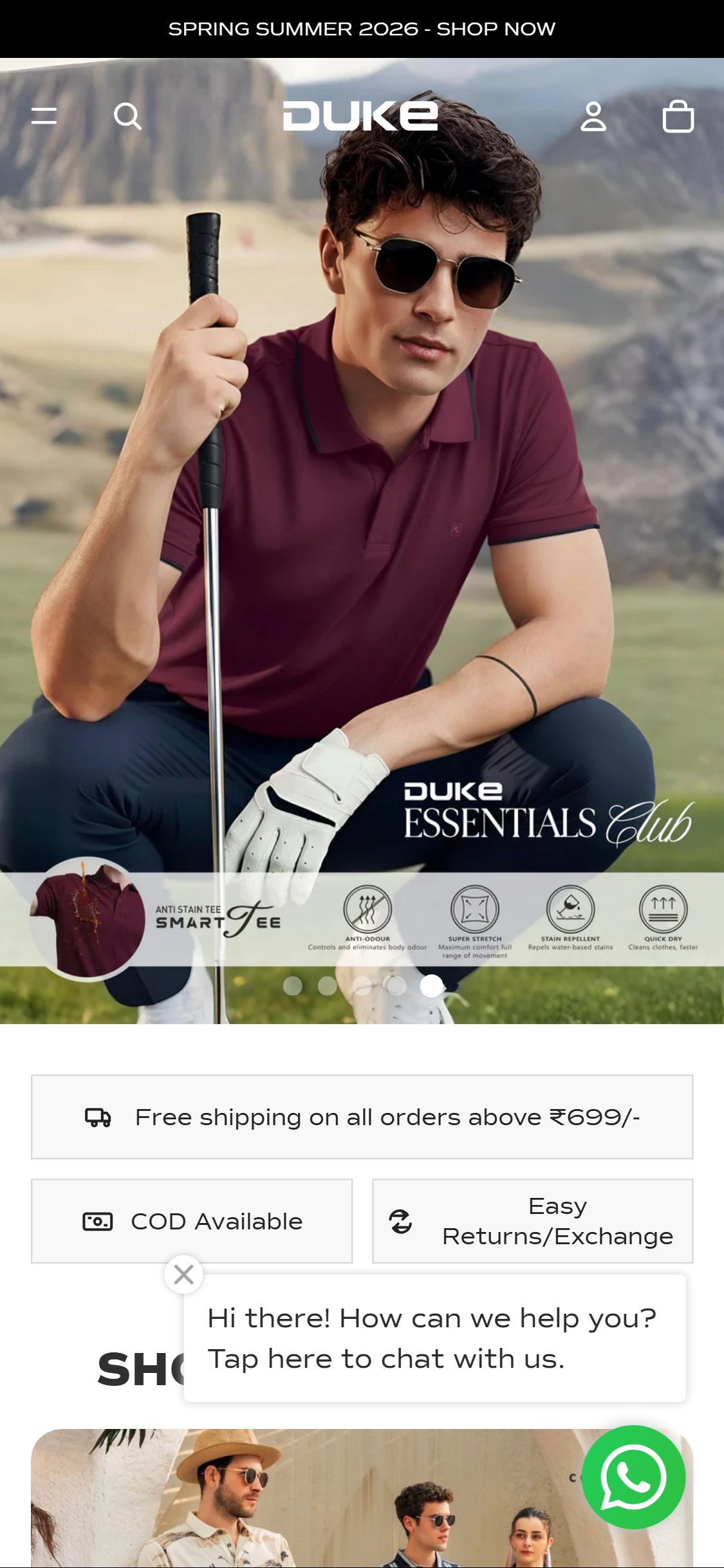
- The announcement bar currently reads 'SPRING SUMMER 2026 — SHOP NOW' — a seasonal brand message with no discount, offer, or urgency element.
- Shoppers arriving from paid or organic channels see no immediate value signal at the top of the page, reducing the incentive to browse further.
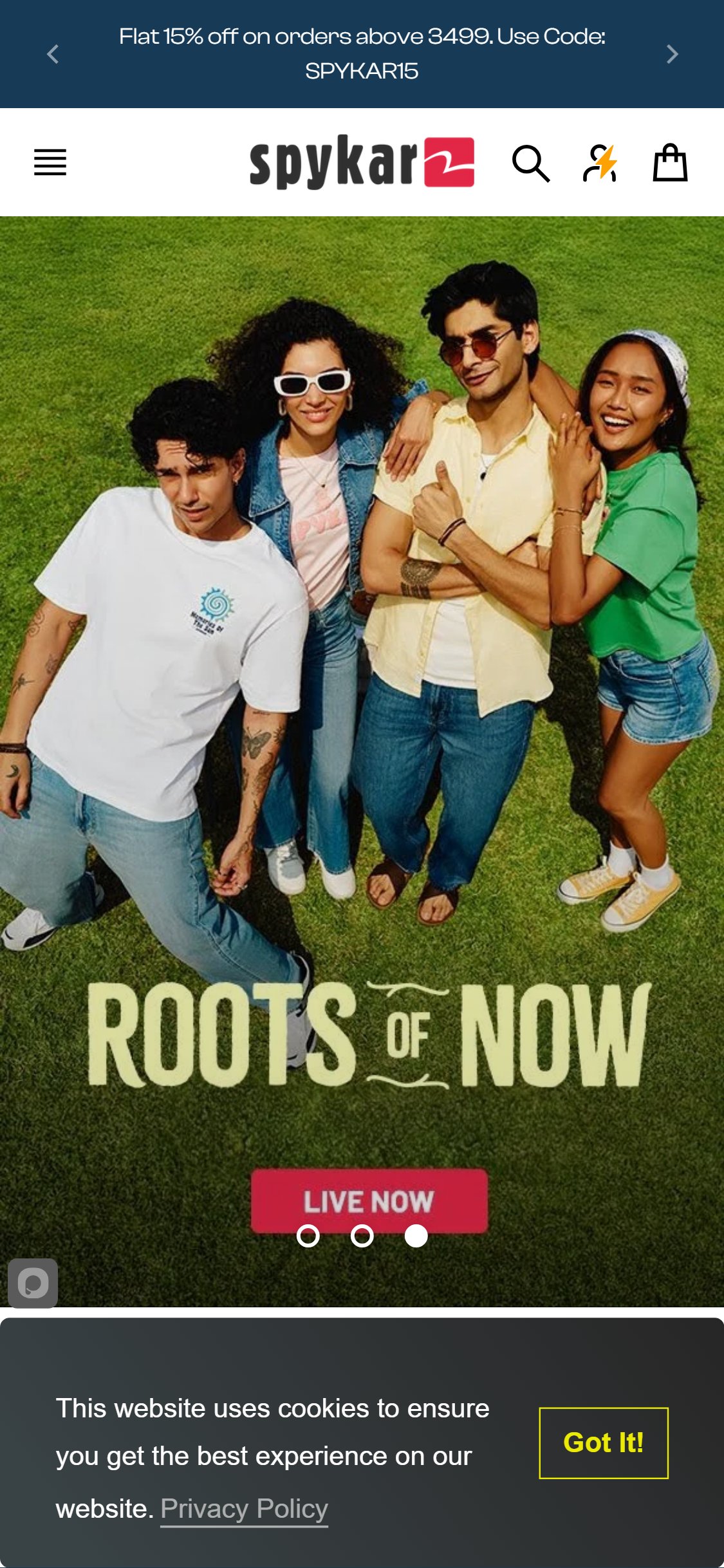
- Competitor Spykar uses the same bar slot to communicate two specific discount codes (10% off above ₹2,499 and 15% off above ₹3,499), which also nudges order value upward.
- Missing a promo bar offer is a lost top-of-funnel conversion trigger — industry data shows offer-led bars generate 5-8% higher click-through into collection pages.
- Replace or supplement the seasonal message with a live discount offer or free-shipping threshold (e.g., 'Free delivery on orders above ₹999 | Use code DUKE10 for 10% off').
- Use a rotating/carousel announcement bar to show multiple messages — seasonal launch + active offer + trust signal (e.g., 'Easy Returns within 30 days').
- A/B test offer-led bar vs brand-led bar to confirm lift before permanent change.
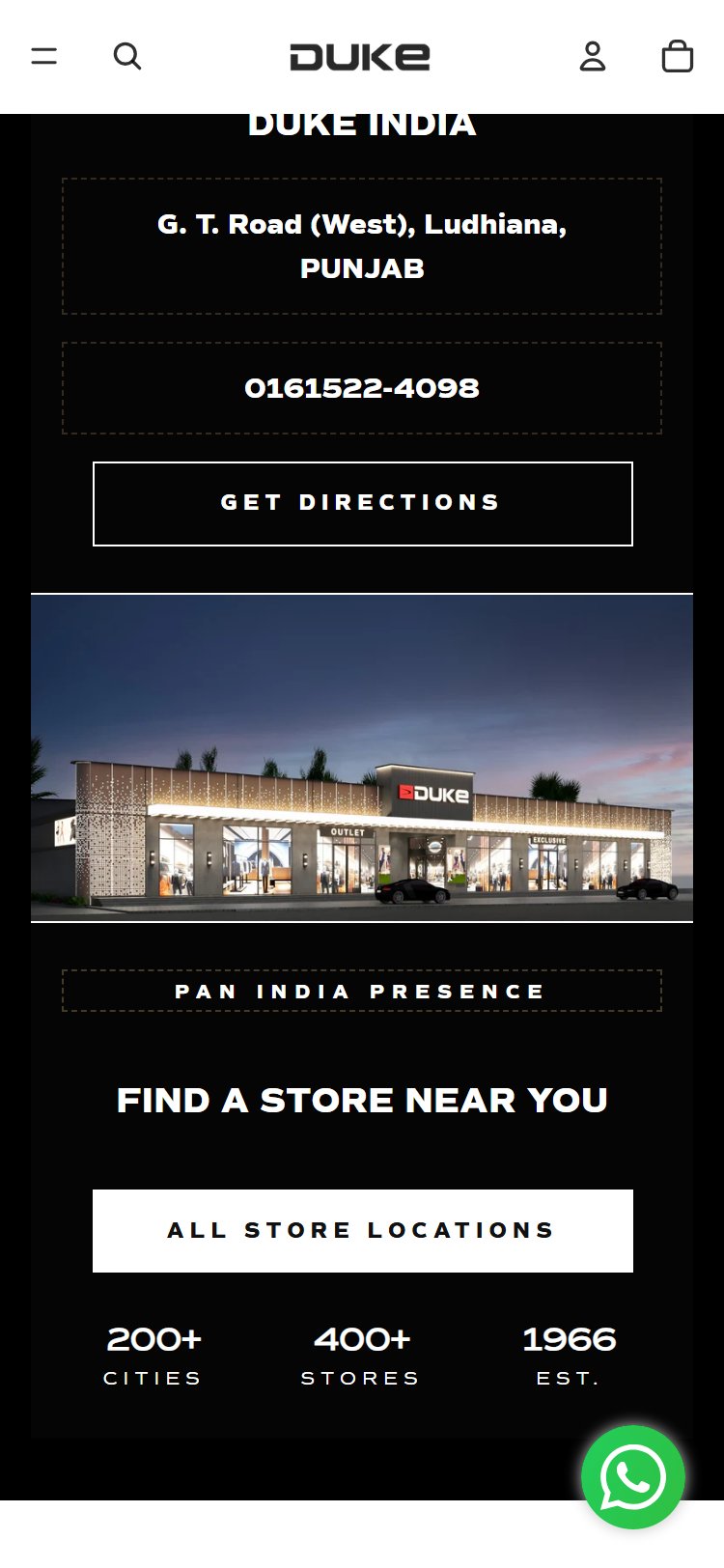
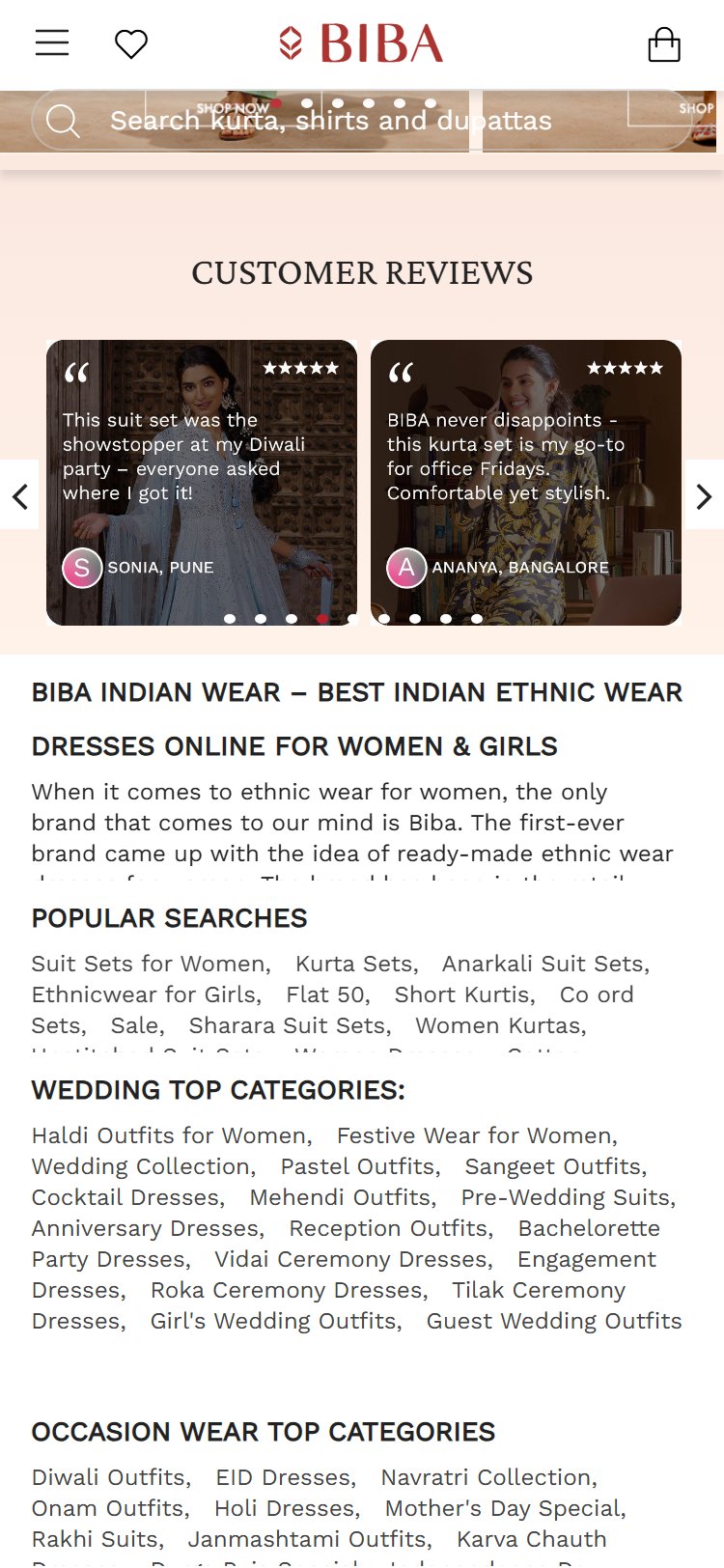
- The Duke India homepage contains no customer reviews, testimonials, press/media logos, or platform rating display (Google, Trustpilot, etc.).
- First-time visitors — the majority of traffic from paid and organic channels — have no social signal to validate the brand before browsing, which increases bounce rate.
- BIBA features a dedicated 'CUSTOMER REVIEWS' carousel section on their homepage; Spykar has a 'Testimonials — What do our customers say?' section with customer quotes — both establish social proof at the homepage level.
- Research consistently shows that social proof on key landing pages lifts conversion 10-15% by reducing new visitor hesitation, especially for mid-premium apparel priced ₹1,000–₹3,000+.
- Add a homepage review carousel pulling from existing customer reviews — even 5-10 curated reviews with star ratings and customer names significantly improve trust.
- If Duke India has press coverage or retail presence data (e.g., '50+ years of heritage', 'Available in 500+ stores'), format these as credibility badges above the fold.
- Install a review app (Judge.me or Yotpo) to systematically collect and display reviews across PDP and homepage.
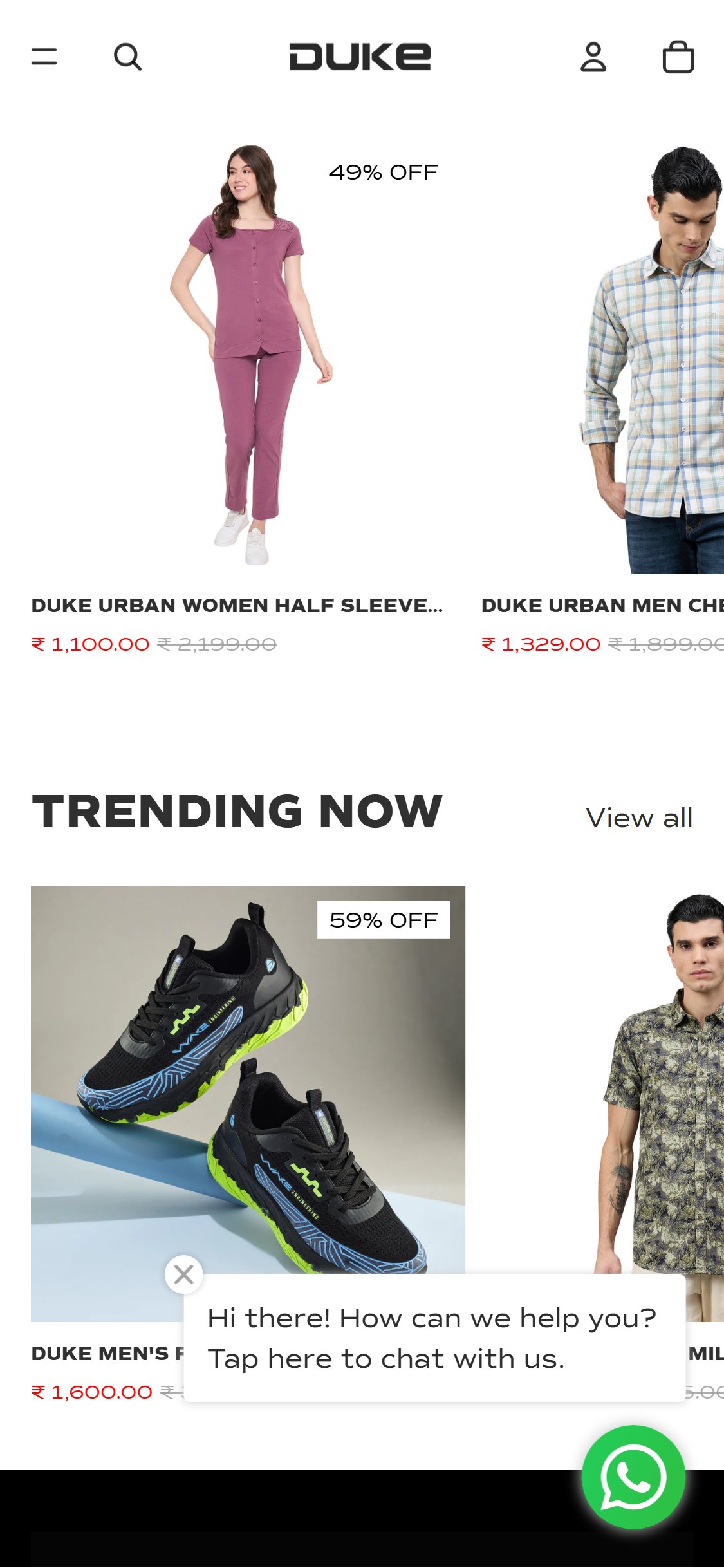
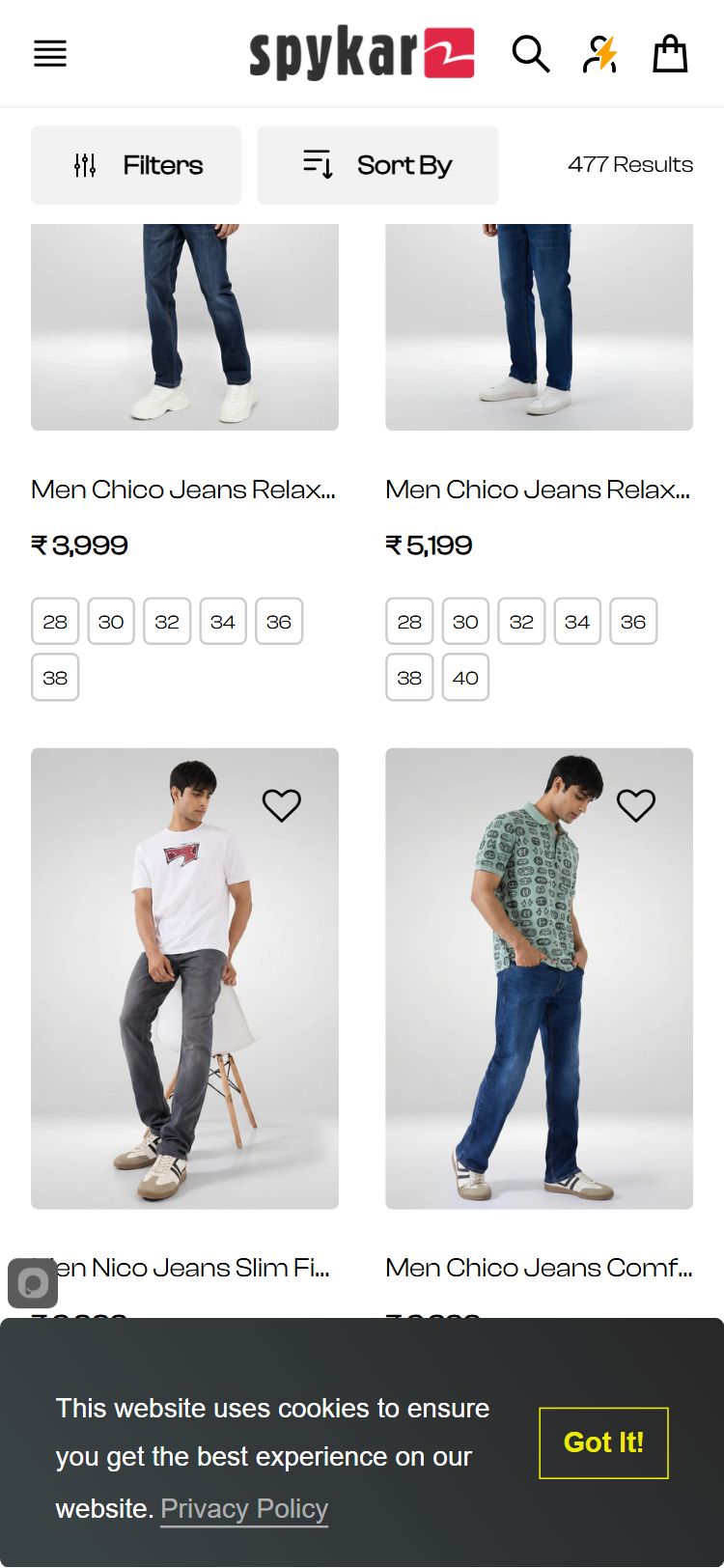
- Duke India product cards on homepage and collection pages show only product image, name, and price — no color swatches, size availability indicators, or star ratings.
- Shoppers browsing a clothing brand need to know available colors and sizes before clicking into a PDP; the absence of this information forces multiple PDP visits to find the right variant.
- BIBA displays star ratings (e.g., '5 out of 5 Customer Rating') and color swatches directly on collection cards; Spykar shows size availability pills (28, 30, 32, 34, 36, 38) on every card — both reduce friction in the browse-to-buy journey.
- Color swatch display on cards is adopted by 4/10 Indian fashion stores but has strong conversion impact — it reduces back-navigation and increases add-to-cart rate from collection pages.
- Add color swatches to product cards showing available colors; clicking a swatch should change the card image to that color variant.
- Add star rating display on cards once review data is collected (even an average of 4+ stars with review count builds confidence at the browse stage).
- Flag 'Low Stock' or 'Sold Out' directly on cards to add urgency and prevent wasted PDP visits.
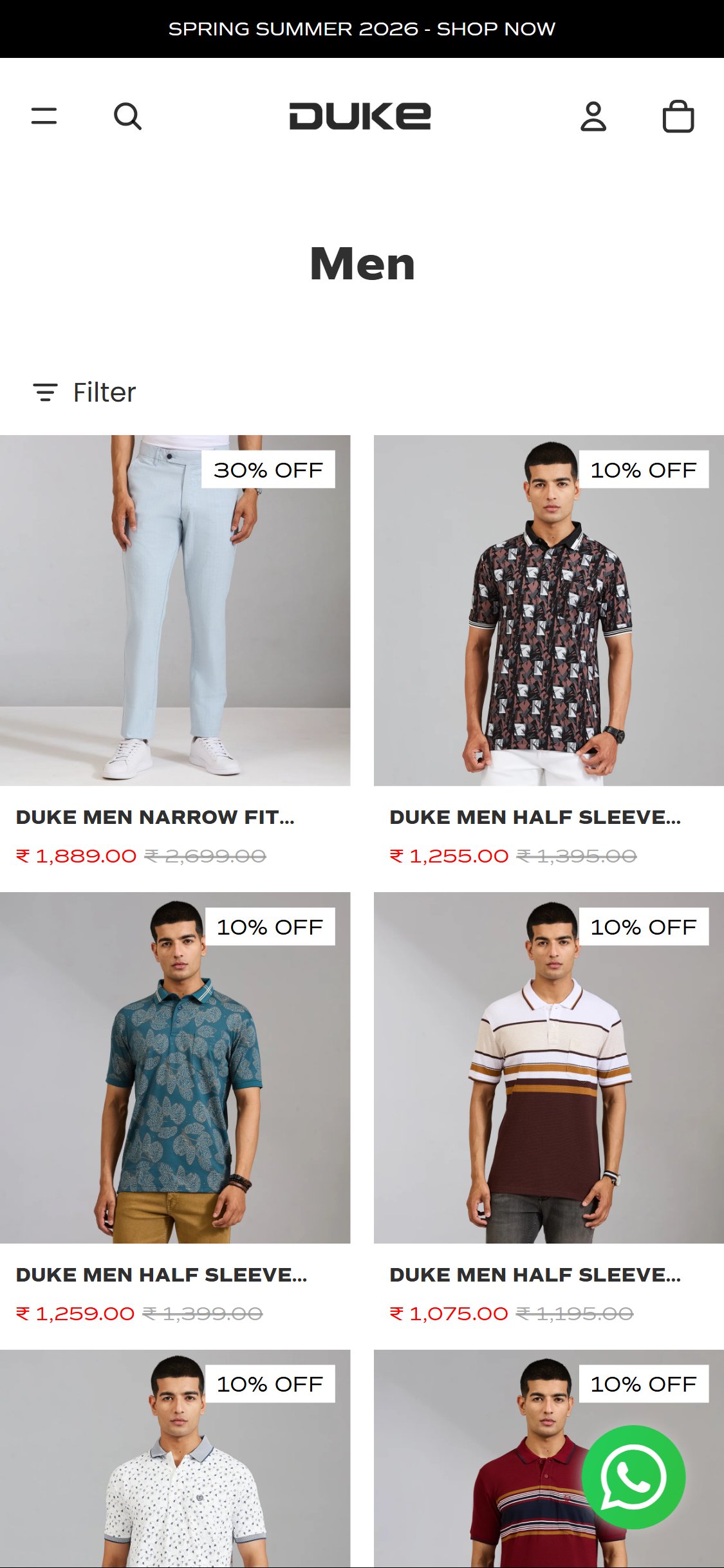
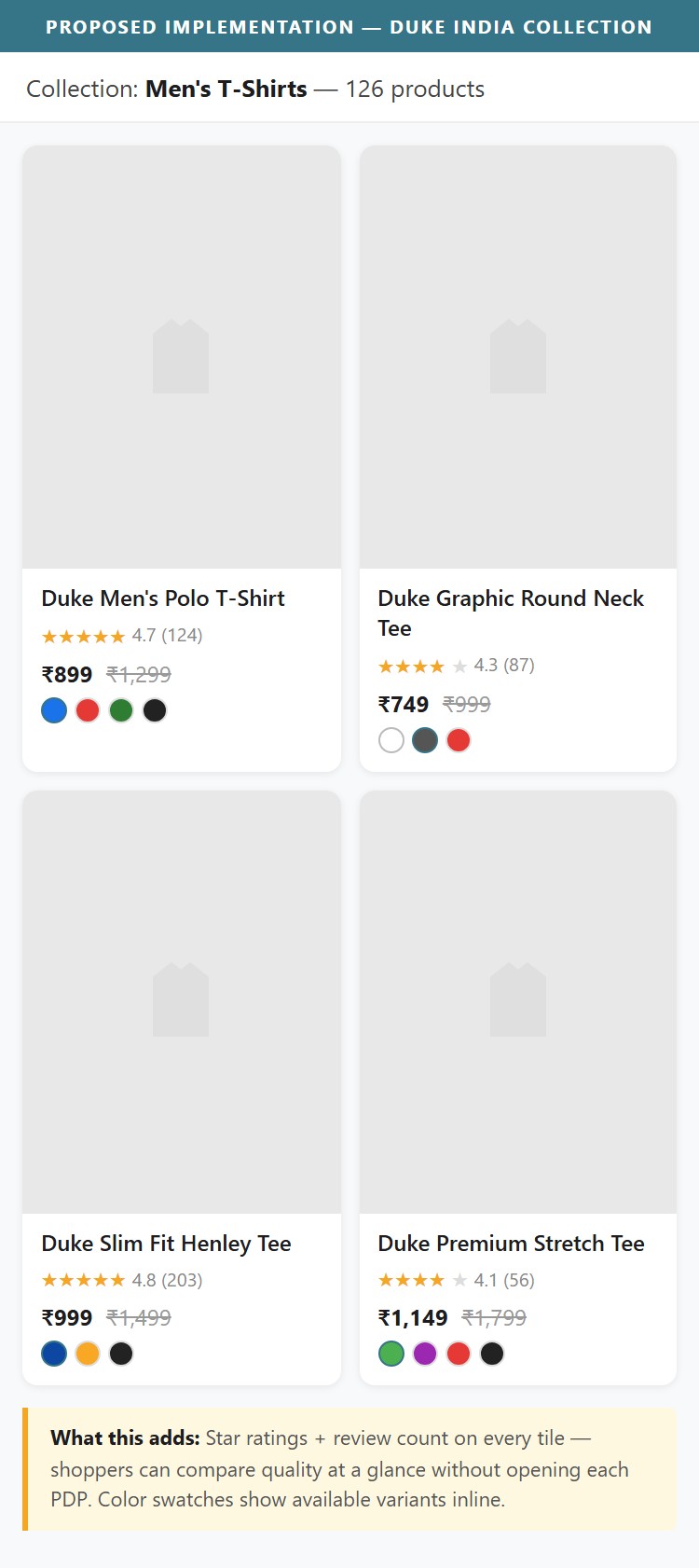
- Duke India's collection page product tiles display only product image, name, and price — no star ratings or review counts are shown on any tile.
- Shoppers browsing a large catalog (5,666+ products) rely on ratings to quickly shortlist products worth clicking into; the absence forces them to open each PDP individually to assess quality.
- BIBA shows '5 out of 5 Customer Rating' directly on product tiles; Spykar shows size availability on cards — both competitors enrich their product tiles with decision-supporting signals.
- Research shows products with visible star ratings on collection pages achieve 15-20% higher click-through rates versus those without, especially for new visitors unfamiliar with the brand.
- Enable star rating display on collection product tiles once a review app (Judge.me/Yotpo) is installed — most review apps provide a native Shopify block for collection card ratings.
- Initially surface ratings only on products with 5+ reviews to avoid showing unrepresentative ratings on new SKUs.
- Pair with review count (e.g., '4.5 ★ (32)') for credibility — a rating with a count is significantly more trusted than a score alone.
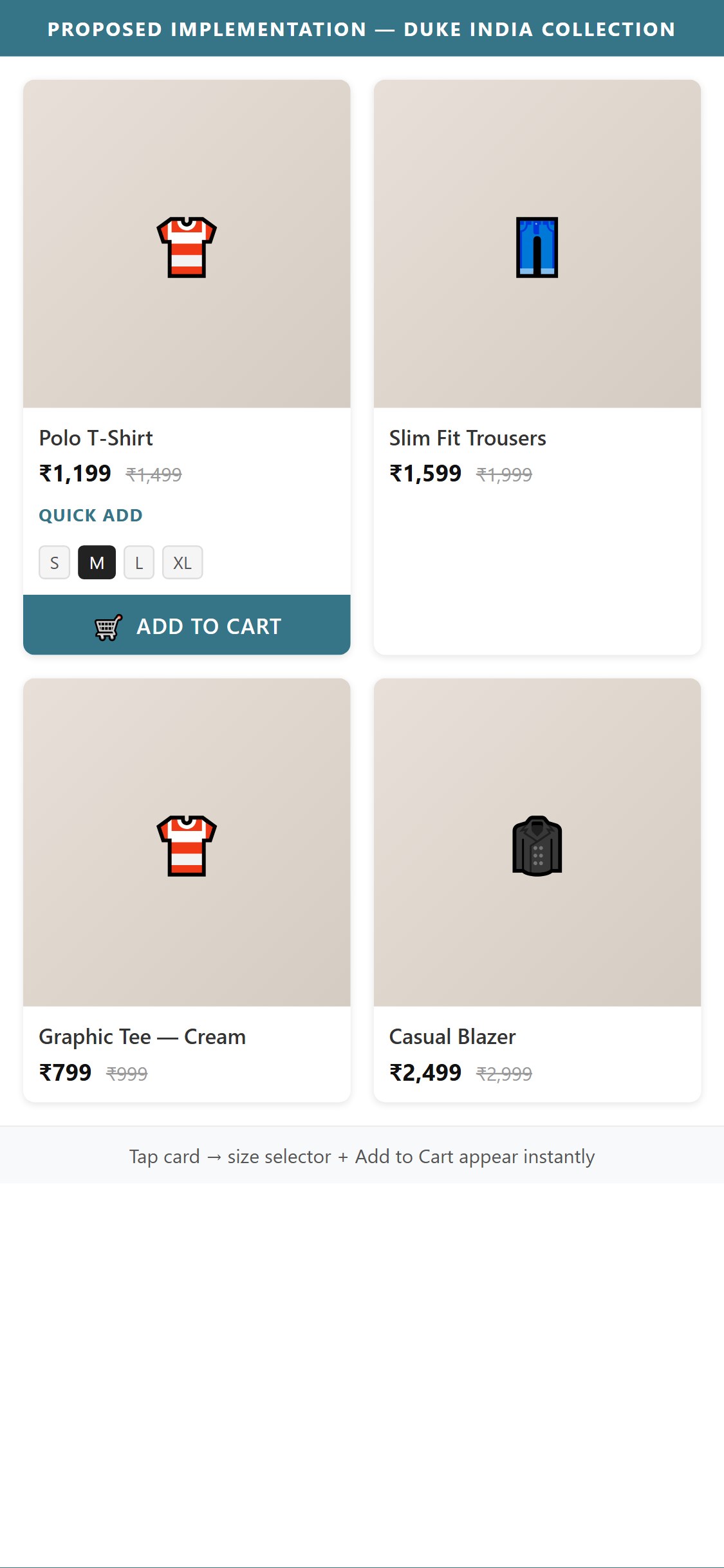
- While Duke India product cards have a 'More' button (leading to PDP), there is no quick-add-to-cart option that allows adding a product directly from the collection grid.
- Shoppers who already know their size and color preference must navigate to the PDP, select variants, then add to cart — adding 2-3 unnecessary steps for repeat buyers.
- Quick-add is especially impactful for apparel basics (T-shirts, trousers, socks) where decisions are quick and variant selection is simple.
- 10-15% improvement in ATC rate is achievable for catalog items with fewer than 3 variant combinations when quick-add is implemented correctly.
- Add a quick-add overlay or bottom sheet that appears on card tap/hover, showing a compact variant selector (color + size) and an Add to Cart button.
- For products with a single variant or limited options, allow direct add-to-cart from the card without a modal.
- Ensure the quick-add interaction triggers the GoKwik cart drawer to maintain checkout flow consistency.

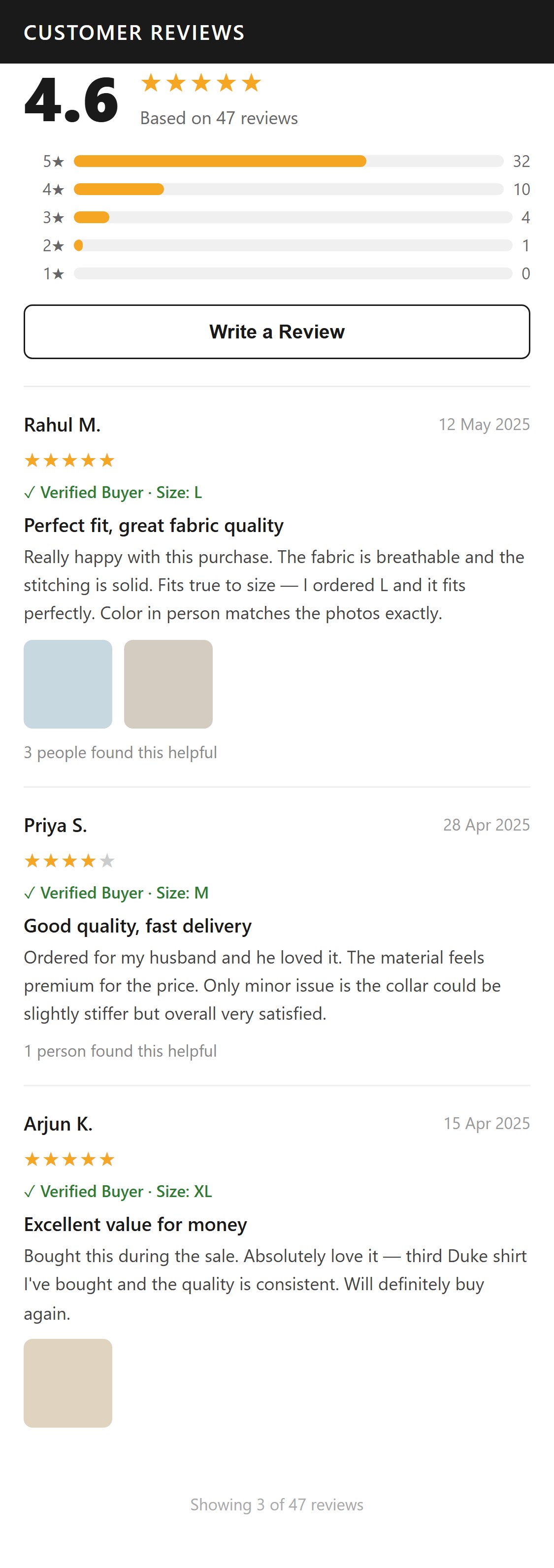
- Duke India PDPs have no customer reviews, star ratings, or review summary — the review section is entirely absent with no review app scripts loaded.
- For apparel priced at ₹1,000–₹2,500+, shoppers frequently check reviews before purchasing, especially for fit accuracy, fabric quality, and color accuracy vs. photos.
- None of the three audited competitors (Spykar, BIBA, ColorPlus) currently show populated reviews on their PDPs — highlighting this as a sector-wide gap and a first-mover advantage opportunity for Duke India.
- Fashion category data shows PDPs with reviews convert 15–20% higher than those without — this is the single highest-impact PDP gap identified in this audit.
- Install Judge.me (free tier) or Yotpo to collect and display product reviews — prioritize top 20 bestselling SKUs for initial review collection via email campaigns.
- Enable review display on PDP with star summary at top (average rating + count), individual review cards with reviewer name, date, and size purchased.
- Request post-purchase review emails at 7 and 14 days after delivery to build review volume quickly.
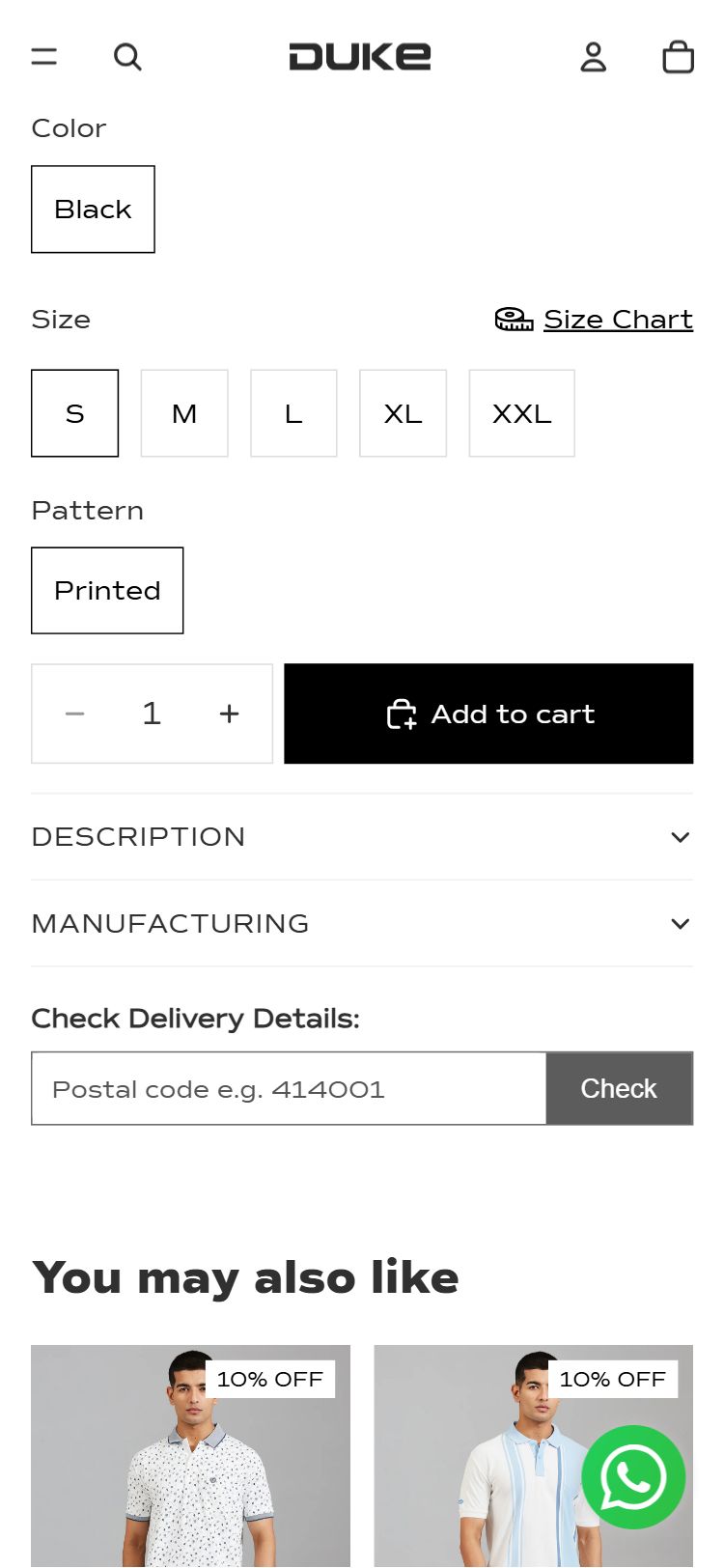
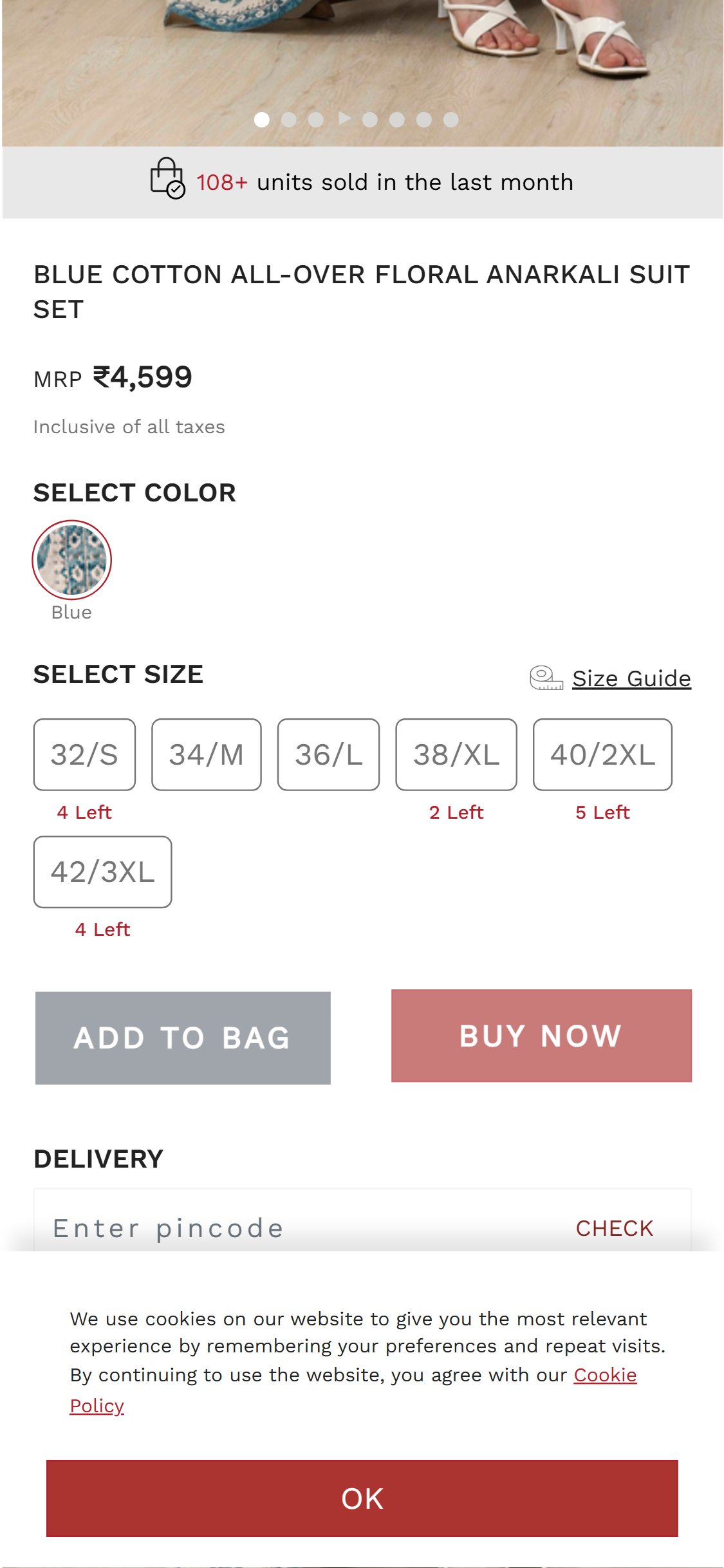
- Duke India PDPs show only variant selectors and an Add to Cart button with no trust badges, no COD indicator, no returns policy, and no payment icons anywhere near the ATC area.
- First-time shoppers on Indian D2C stores frequently abandon at the ATC step due to uncertainty about shipping costs, return policy, and payment safety - visible trust signals reduce this friction directly.
- BIBA displays a four-icon USP strip (Free Shipping / 7 Days Easy Return-Exchange / Assured Quality / COD Available) immediately below their ATC button, addressing the four main pre-purchase concerns in one row.
- Duke India already offers COD via GoKwik and free shipping thresholds - these benefits are invisible on the PDP, meaning the brand is leaving conversion value on the table.
- Add a compact trust strip (4 icons maximum) immediately below the Add to Cart button - include COD Available, Free Shipping (with threshold), Easy Returns (X days), and Secure Payments.
- Use SVG icons with short text labels (max 3 words each) to keep the strip scannable; ensure it renders correctly on mobile at 375px width.
- Configure GoKwik to surface the COD availability indicator dynamically so pincode-specific COD eligibility is reflected in the trust strip.
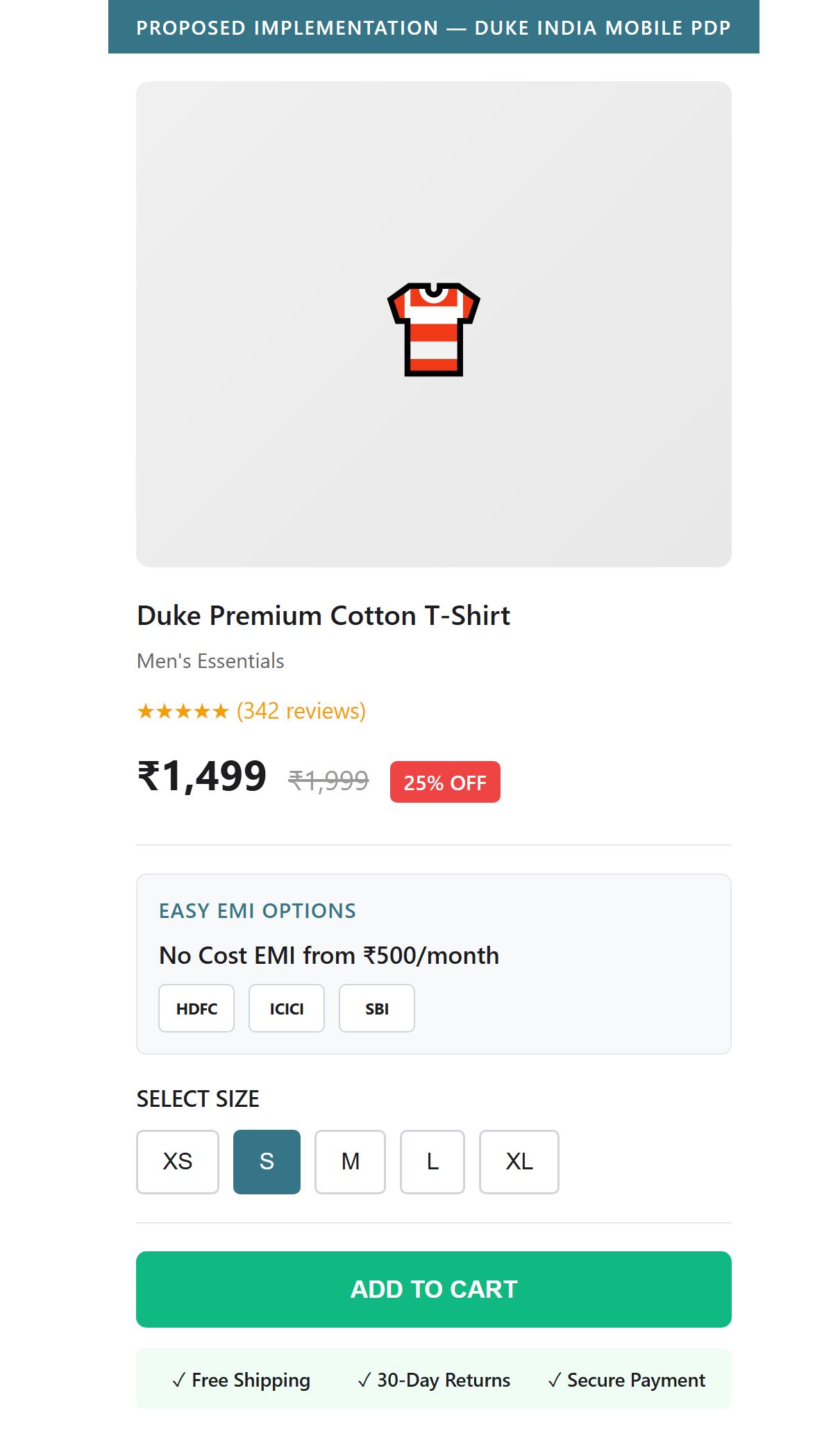
- Duke India PDPs show only the sale price and original price — no EMI breakdowns, BNPL (Buy Now Pay Later), or bank-specific offer callouts are present.
- With products priced ₹1,000–₹3,500, breaking down the cost to 'Just ₹X/month with No Cost EMI on HDFC/ICICI' can directly overcome price hesitation for mid-range buyers.
- GoKwik (Duke's checkout provider) supports EMI and BNPL options at checkout, but not surfacing these options on the PDP means shoppers don't consider the purchase as affordable until after they've already decided to buy.
- Bank-specific EMI callouts (HDFC, ICICI, SBI) are used by 5/10 top Indian D2C fashion stores and are particularly effective for the ₹2,000–₹5,000 price band.
- Add a line below the price block: 'EMI from ₹X/month | No Cost EMI on HDFC, ICICI, SBI cards' — this text is static and requires no backend integration.
- Coordinate with GoKwik to confirm which EMI/BNPL options are active at checkout and surface the same options on PDP for consistency.
- Consider adding a 'Bank Offers' expandable section showing active card discounts (e.g., 'Extra 10% off with HDFC Credit Card').
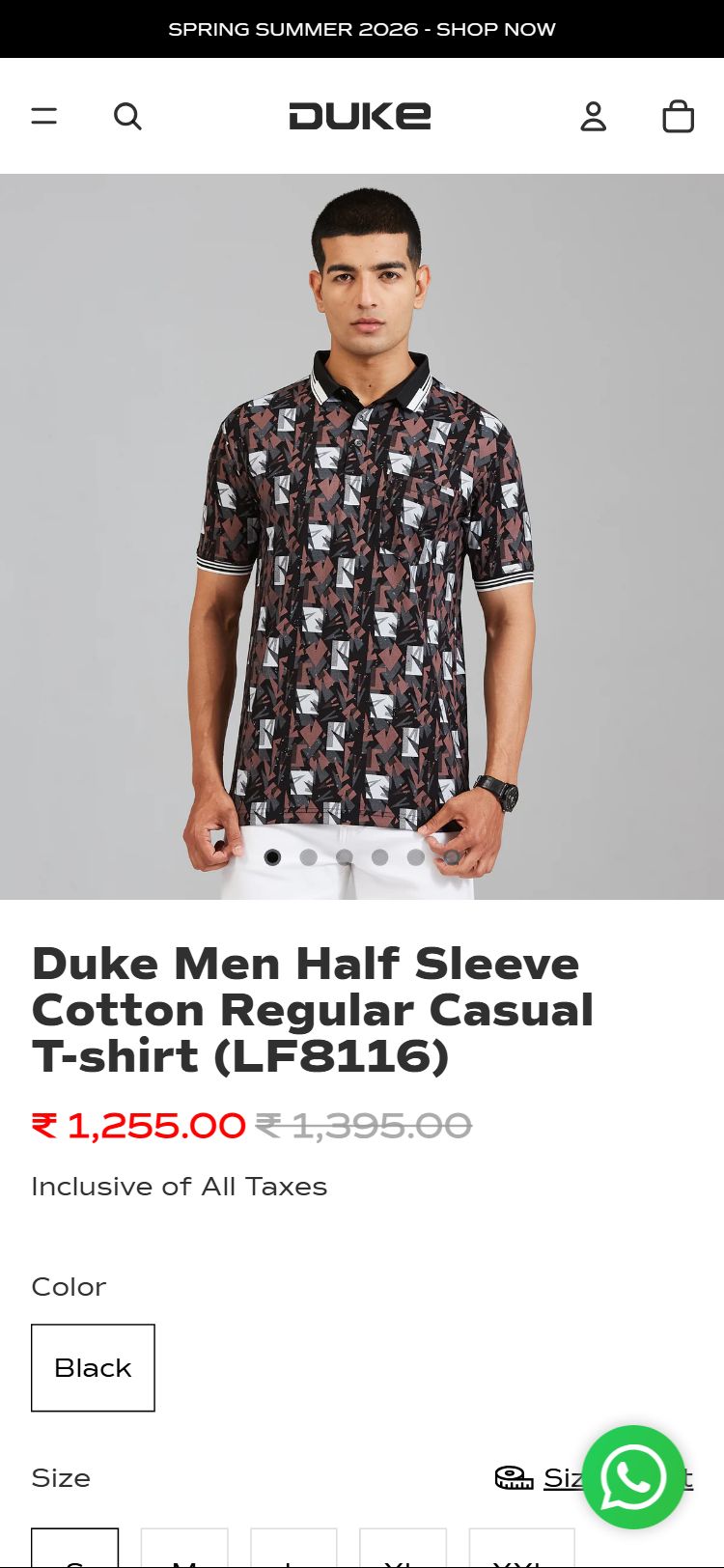
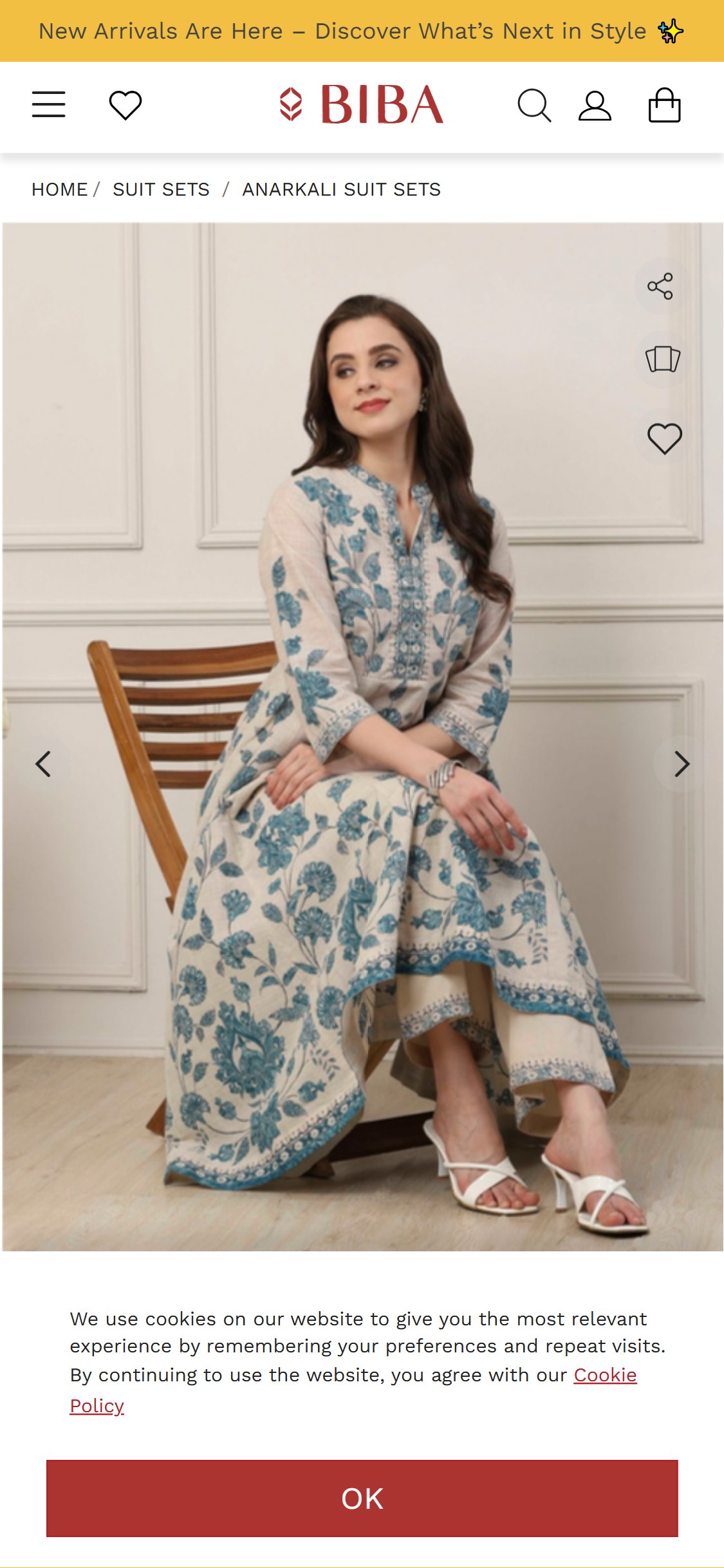
- Duke India PDPs have no breadcrumb navigation — shoppers landing on a PDP from search or a social ad have no contextual trail to navigate back to the parent category.
- Without breadcrumbs, the only back-navigation option is the browser back button, which risks losing the session if the shopper came from an external source.
- BIBA implements full 3-level breadcrumbs (HOME / SUIT SETS / ANARKALI SUIT SETS) with BreadcrumbList JSON-LD schema on every PDP; Spykar has 2-level breadcrumbs (Home / Product Name) — both outperform Duke India's absent navigation.
- Breadcrumbs also provide SEO benefit via BreadcrumbList schema markup, enabling Google to show site structure in search results.
- Add breadcrumb navigation to PDP template: Home > [Gender] > [Category] > [Product Name], with each segment linking to the corresponding collection.
- Implement BreadcrumbList JSON-LD schema alongside the visual breadcrumbs to enable rich snippets in Google Search.
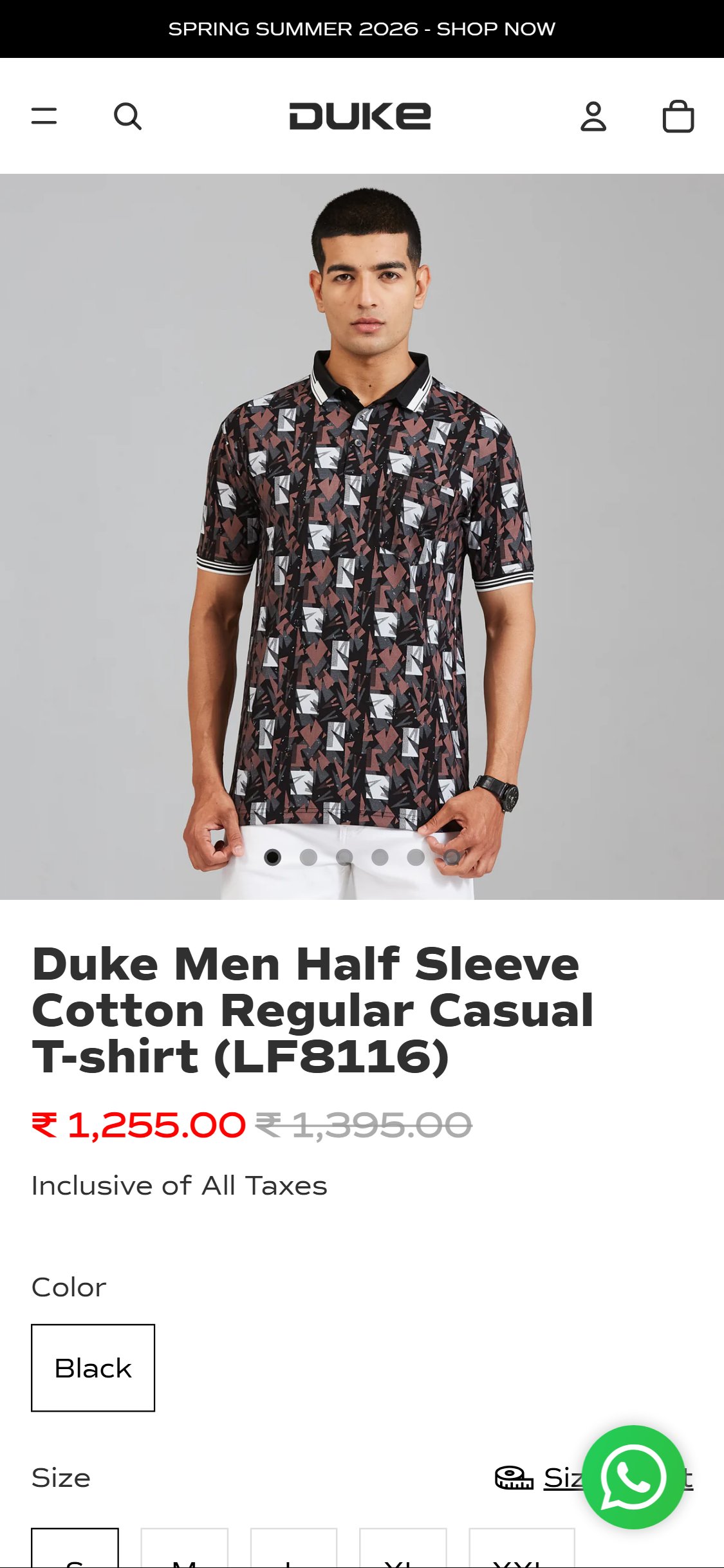
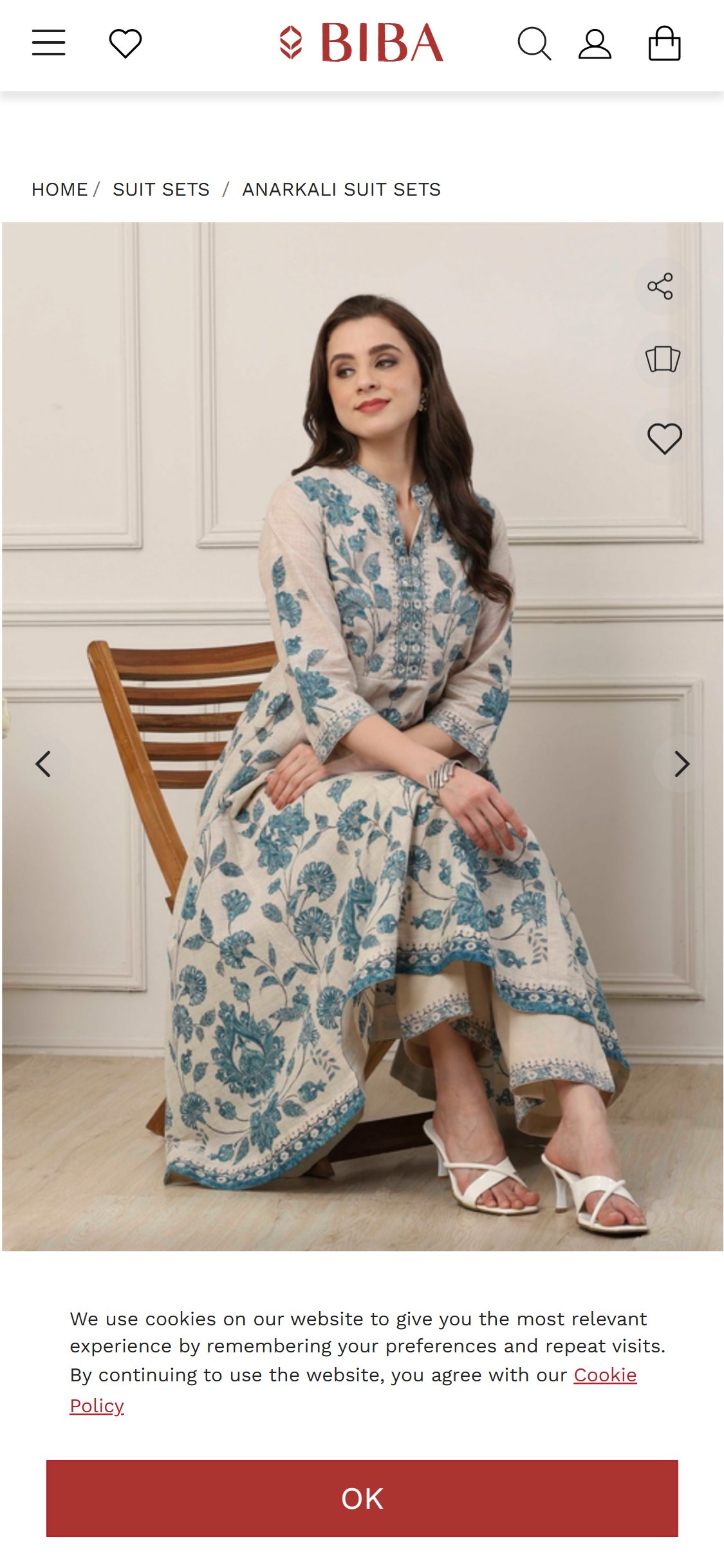
- Duke India PDPs contain no Product JSON-LD schema markup - Google cannot generate rich results (price, availability, star ratings) for Duke India product queries, reducing organic CTR vs. schema-equipped competitors.
- No BreadcrumbList schema means Duke India PDPs do not display breadcrumb paths in Google SERPs - breadcrumb-enriched results receive 15-30% higher CTR than plain blue-link results for fashion queries.
- BIBA implements full Product JSON-LD with @type:Product, name, price, availability, and BreadcrumbList schema on every PDP - their products appear with structured data in Google Shopping and organic results.
- Duke India has 5,666+ active SKUs - at current organic traffic levels, implementing schema across all PDPs represents a compounding SEO advantage that grows with every new product added.
- Add Product JSON-LD schema to all PDP templates via theme.liquid or a Shopify metafields-driven script block - include name, brand, sku, price, priceCurrency, availability, image, and description fields.
- Add BreadcrumbList JSON-LD schema reflecting the collection hierarchy (e.g., Home > Men > T-Shirts > Product Name) and add visible breadcrumb HTML navigation above the product title.
- After implementation, submit updated sitemaps in Google Search Console and use the Rich Results Test to verify schema validity for at least 5 representative PDPs.
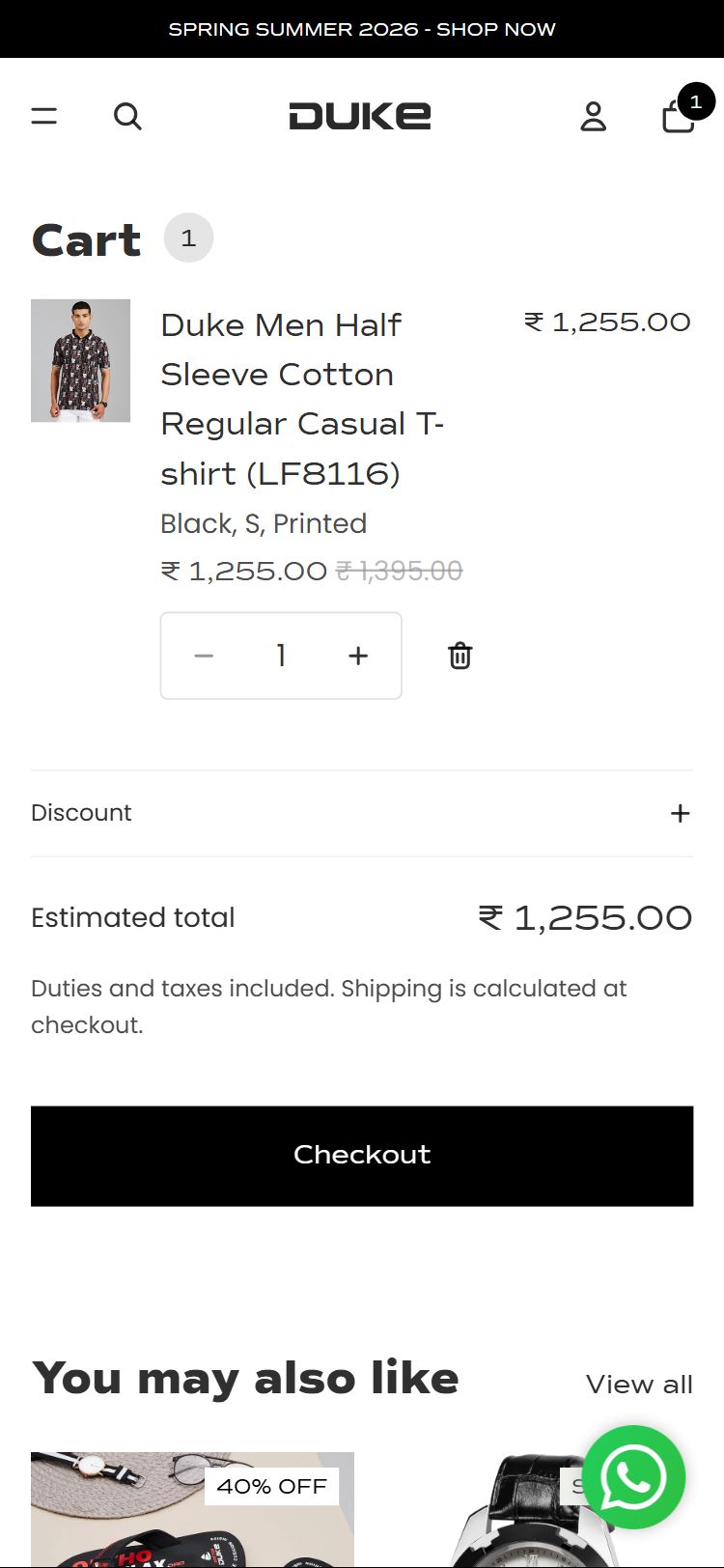
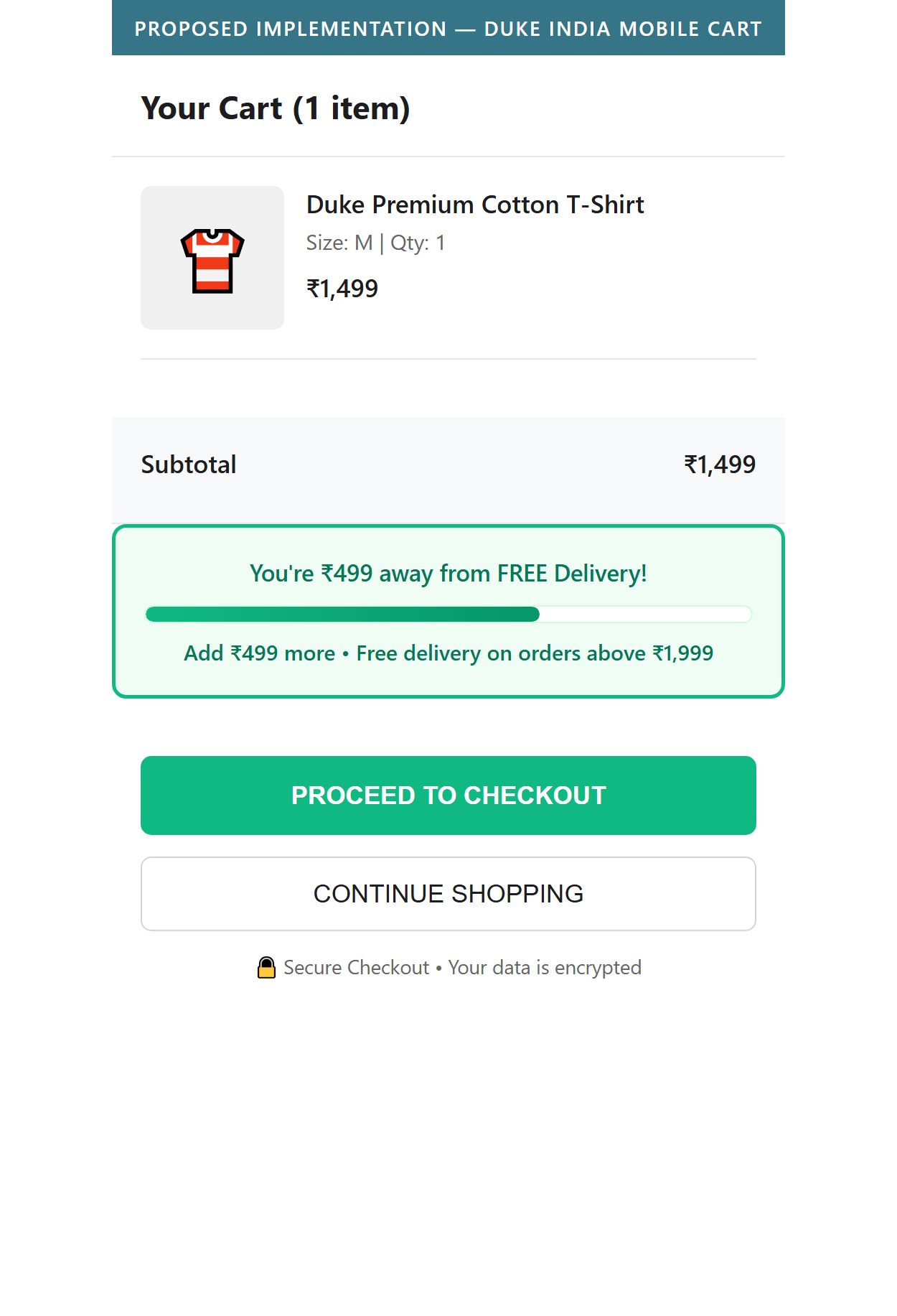
- Duke India's cart page shows the order subtotal and a 'Checkout' button but has no free-shipping threshold progress bar or message encouraging the shopper to add more items.
- The cart body text confirms 'Duties and taxes included. Shipping is calculated at checkout' — the shipping cost is unknown to the shopper until they reach checkout, creating a surprise cost drop-off.
- None of the three audited competitors (Spykar, BIBA, ColorPlus) have implemented a free shipping progress bar — however this pattern is adopted by 7/10 top Indian D2C fashion stores and is a high-ROI cart optimisation.
- GoKwik (Duke's checkout app) supports free-shipping threshold messaging in the cart drawer — this is a configuration change, not a development task.
- Set a free delivery threshold (e.g., ₹1,499 or ₹1,999) and display a dynamic progress bar on the cart page: 'Add ₹X more for FREE Delivery!'
- Position the bar prominently above the checkout button so it's the last thing the shopper sees before proceeding.
- Ensure the threshold amount is also shown on PDP and collection pages to set expectations early in the journey.
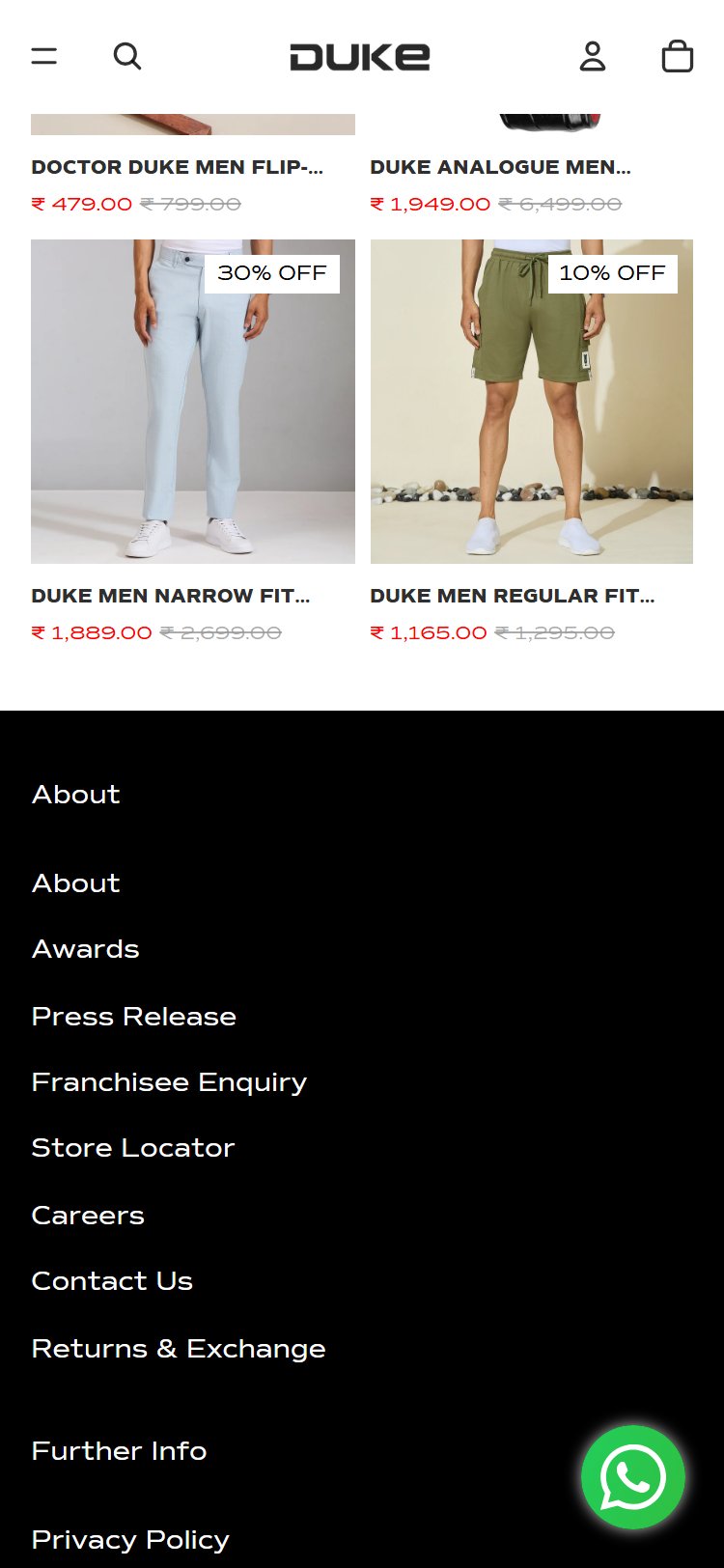
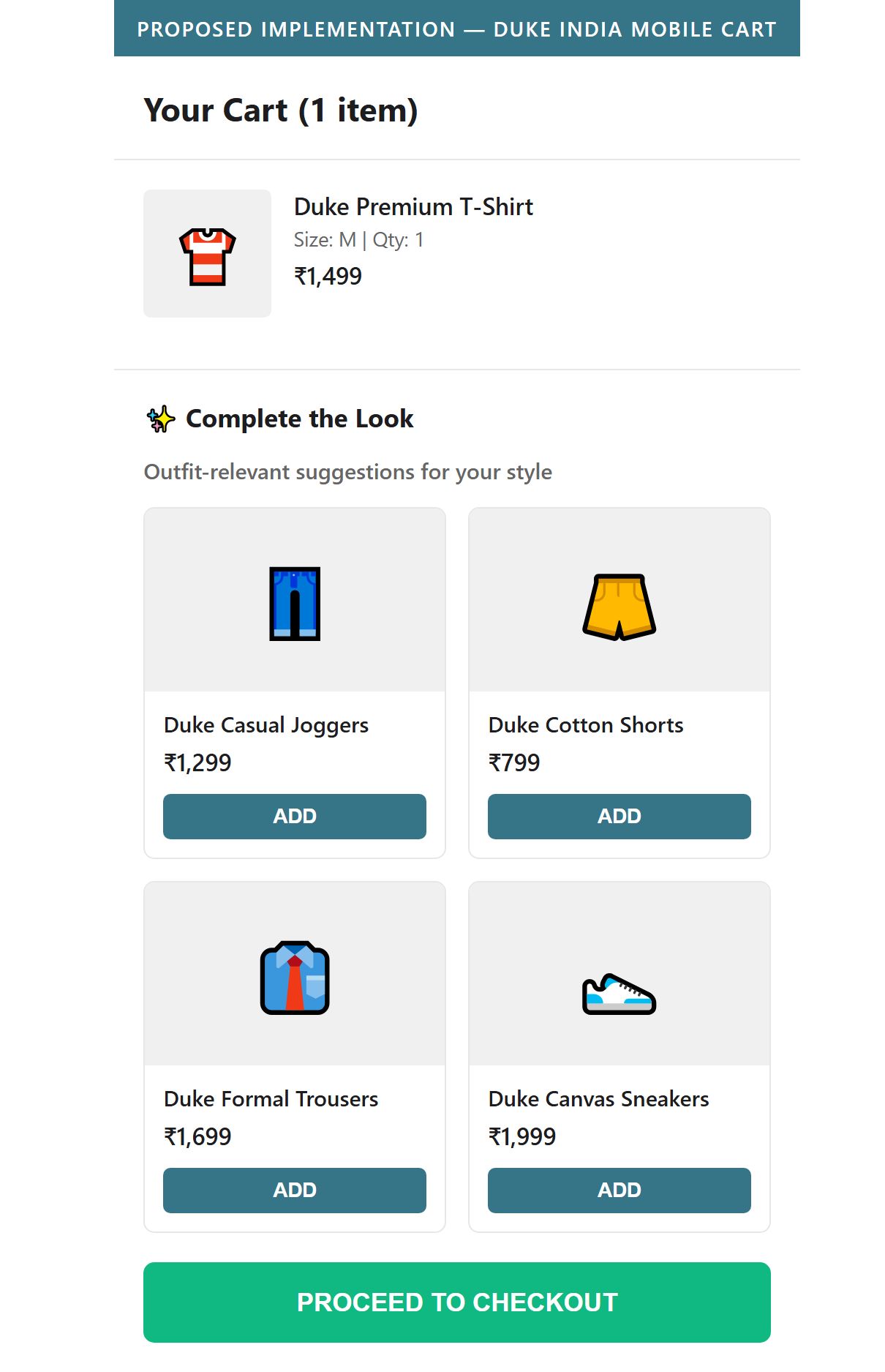
- Duke India's cart page shows a 'You may also like' section but the recommendations are generic — a shopper with a T-shirt in cart is shown watches, flip-flops, and accessories rather than complementary apparel (trousers, shorts, shirts).
- Irrelevant recommendations are ignored or, worse, make the brand feel algorithmically random — reducing trust rather than increasing AOV.
- The current recommendation logic appears to be default Shopify 'related products' which uses tag overlap, not purchase-affinity data.
- Cart cross-sell with category-relevant items (e.g., bottoms for tops, shoes for an outfit) generates 10-15% AOV lift; generic recommendations generate closer to 2-3%.
- Configure the cart 'You may also like' section to show products from the same category or complementary categories (e.g., a T-shirt in cart → recommend joggers, shorts, or casual trousers).
- Use Shopify's product recommendations API with intent=complementary and set complementary products manually for top 50 SKUs.
- Consider a 'Complete the look' framing with outfit-based recommendations to increase perceived value and AOV.
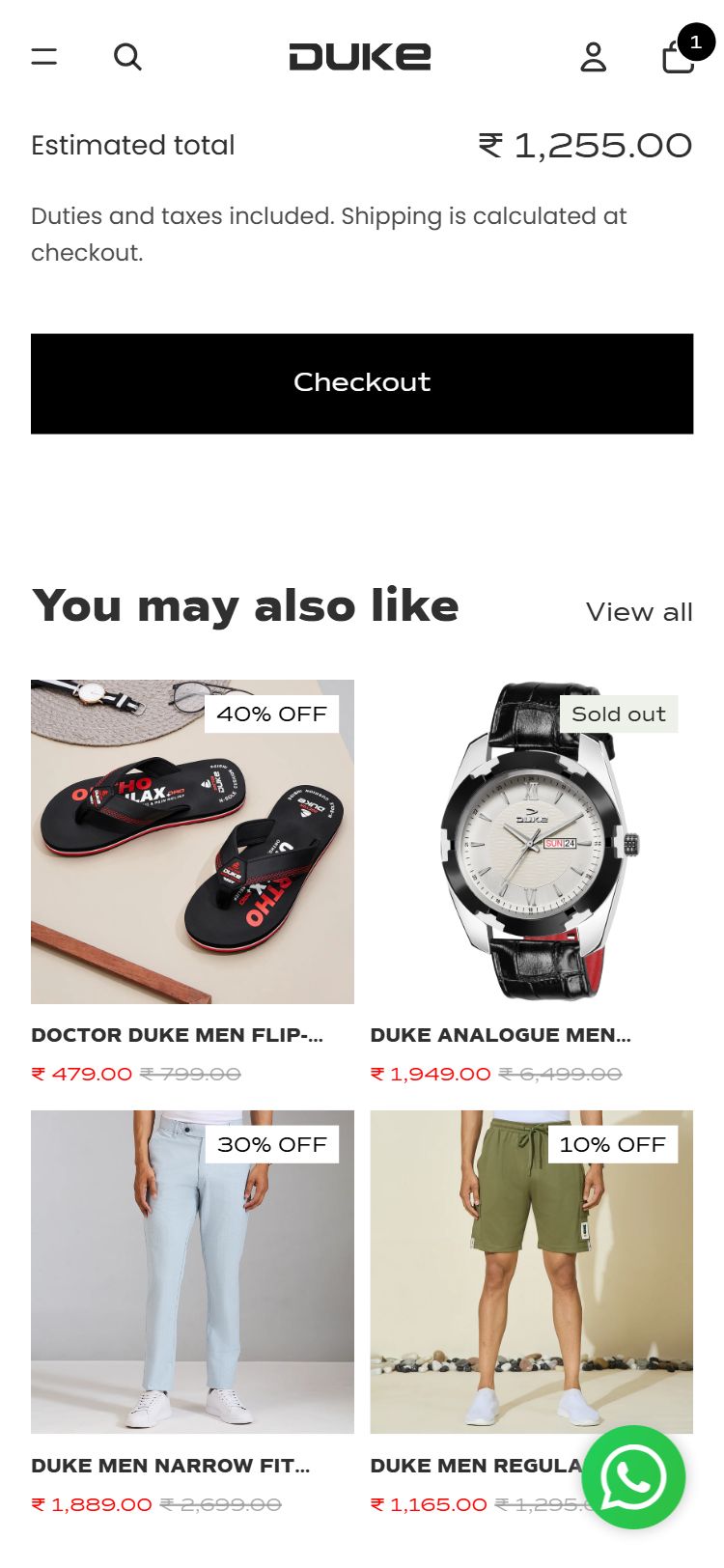
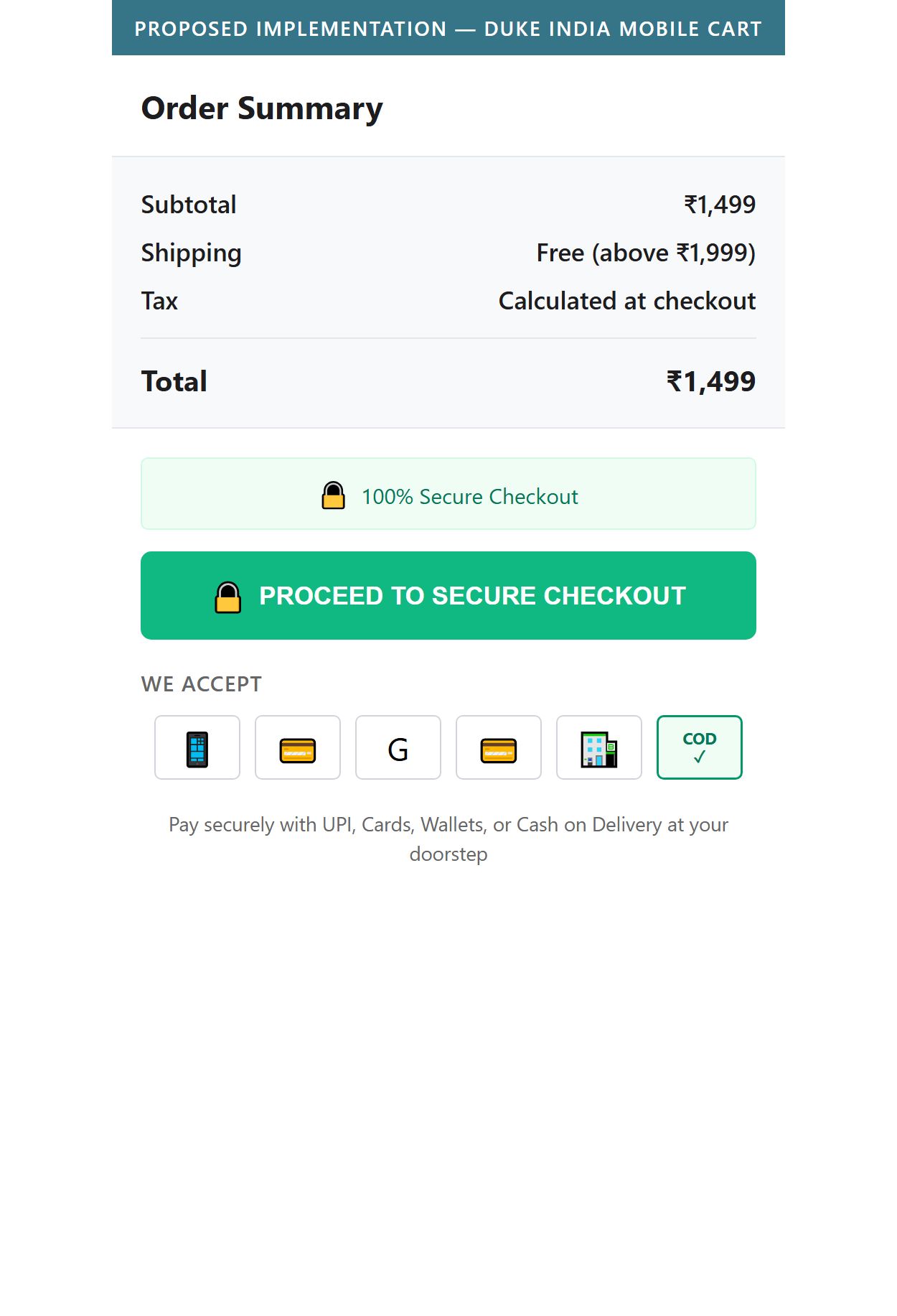
- Duke India's cart page shows the order total and a 'Checkout' button with no indication of accepted payment methods — UPI, COD, credit/debit cards, or wallet options are not mentioned.
- Cash on Delivery (COD) is the preferred payment method for 60%+ of Indian fashion shoppers, especially first-time buyers from Tier 2/3 cities — not confirming its availability before checkout is a trust gap.
- Verified across all three competitor carts: Spykar shows a plain 'Checkout' button with no payment icons; BIBA shows only a text label '100% Secure Payments' with no specific icons — this is an industry-wide gap but should not be treated as acceptable.
- GoKwik handles the actual checkout flow and does offer COD/UPI, but the cart page itself gives the shopper no pre-checkout reassurance that their preferred payment method is available.
- Add a row of payment method icons below the checkout button: UPI, PhonePe, GPay, Visa, Mastercard, and a 'COD Available' badge.
- Add a 'Secure Checkout' label with a padlock icon to the checkout button itself or immediately below it.
- Add a brief reassurance line: 'Pay securely with UPI, Cards, Wallets, or Cash on Delivery'.
Performance & Technology
Core Web Vitals, page-speed signals, and the technology stack powering Duke India
Core Web Vitals
Technology Stack
Performance & Technology Assessment
Mobile performance is needs work (—/100); desktop is needs work (68/100) on Shopify. Page-speed and Core Web Vitals are increasingly load-bearing for SEO and conversion in this category — addressing the weakest vital first is the single highest-leverage technical improvement available.
Confidential — Prepared for Duke India by Growisto | May 2026
App Ecosystem
What's installed vs what's missing from best-in-class Fashion stores
Present (6)
Missing (5)
App Stack Assessment
Duke India has a solid tech foundation with GoKwik, Logisy, and GA4 — but is missing the three highest-impact app categories: a review app (zero social proof), an email marketing platform (no automated flows), and faceted collection filters (5,666+ products with only basic sorting). These three gaps alone represent a combined 40–55% conversion improvement opportunity across the funnel.
Confidential — Prepared for Duke India by Growisto | May 2026